
Find the breach.
Before it becomes the claim.
We find where water is getting into a building, and where it already sits inside the roof.
What brought you here?
The roof is on. Now it needs certifying.
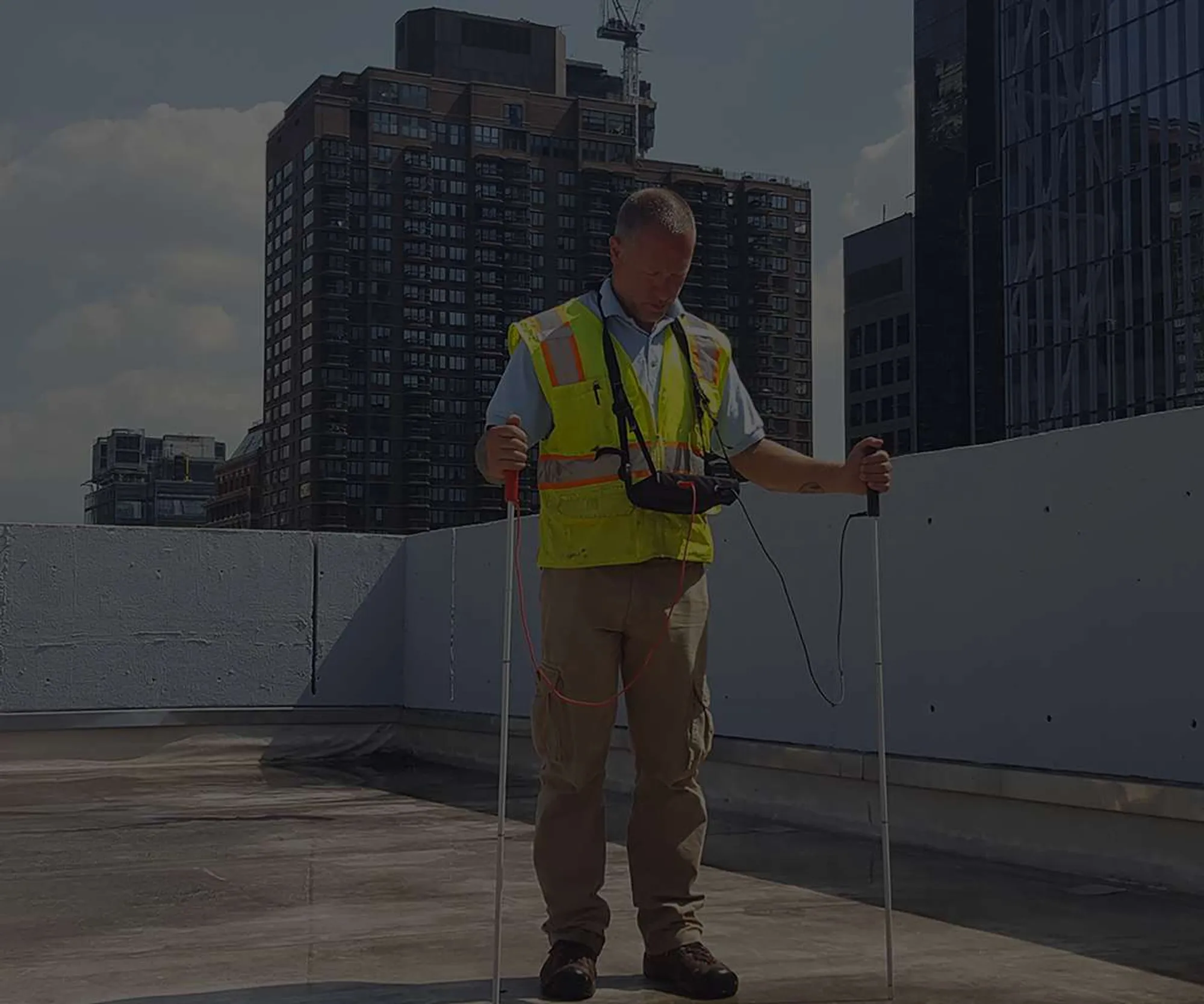
Electronic leak detection proves a new membrane is watertight before anyone signs off, down to the square inch. No flooding the structure, and no waiting for rain.
Electronic leak detection Owners and property managersThere is a leak, and nobody can find it.
A survey maps the wet areas inside the assembly, so you replace the sections that failed instead of the whole roof. Infrared or nuclear, whichever the build-up actually needs.
Roof moisture surveys Architects and spec writersYou are writing the testing into the job.
Standards, scope language, registration numbers and insurance in one place, published rather than sent on request. Written to drop straight into a specification.
Specification resources- SECTION
- Methods
- PRIMARY
- 3 of 7
- REMEDIATION
- None. We sell no repairs.
- NJ RAM LICENCE
- 1050897
RAD250001
Three tests that answer three different questions
Most of our work is one of these, and the hardest part of the job is knowing which one a building actually needs. That decision gets made before anyone is billed.
| Method | Answers | Standard |
|---|---|---|
| Electronic leak detection | Where is the hole? Finds the actual breach in a membrane, to the square inch, without flooding anything. The Detec IntegriScan needs no perimeter wire and covers up to 40,000 square feet a day. It is also the only method that can test black EPDM at all. | ASTM D7877 ASTM D8231 FM Approved |
| Infrared thermography | What is wet, and what else is failing? Reads temperature across 100% of a roof to find saturated insulation, and off the roof it finds failing electrical connections before they fail. | ASTM C1153 |
| Nuclear moisture surveys | What can infrared not see? Reads through ballast, cover boards and overlay after overlay, in daylight and in any weather. Licensed operators, which is a barrier most firms never clear. | NJ 1050897 RAD250001 |
| Air and vapor barrier testing | Does the barrier perform as specified, while it is still exposed and can be corrected? | ASTM E1186 ASTM D4541 |
And a smaller amount of private utility locating, concrete scanning and water main leak detection.
We do not sell the repair we just recommended
A firm that sells roofs has a reason to find a roof that needs replacing. A firm that owns one instrument has a reason to recommend that instrument. Neither is dishonesty. It is what happens when the person diagnosing the problem also profits from the answer.
We only test. And we carry infrared and nuclear both, low voltage and high voltage both, so when we tell you which method your building needs, nothing rides on the answer. The report says what we found and stops there.
Now working in South Florida
Based in Palm Beach, Broward and Miami-Dade, and we travel for work anywhere in Florida.
We carry both, so the method is chosen on what the roof needs rather than on what we own. Most firms carry one and sell you that one.
Talk to someone who has been on the roof
Tell us the building, the assembly and what you are seeing. If testing is not the right answer, we will say so.